
2025 Natural and Working Lands Carbon Inventory Update
Natural and working lands (NWL) exchange carbon and other greenhouse gases (GHGs) with the atmosphere, and thus play a critical role in California's climate strategy. Conservation, restoration, and other land management actions offer opportunities to sustainably store carbon, buffer climate impacts, and promote additional co-benefits for California's landscapes and the communities that rely on them. As such, NWL have been long recognized and increasingly incorporated into California's climate strategy, including through the 2022 Scoping Plan update and the development of the AB 1757 Nature-Based Solution Climate Targets.
In support of these efforts, The California Air Resource Board's (CARB) NWL Carbon Inventory provides a quantitative estimate of organic carbon stored in California’s landscapes, with the 2025 update reflecting conditions as of 2022. It captures the influence of climate, wildfire, other disturbances, land-use change, and management on carbon stocks and stock change, including in vegetation (hereafter called ‘biomass’), soils, and harvested wood products. This information is used to evaluate progress towards California’s climate and carbon neutrality targets, including the 2022 Scoping Plan NWL carbon target, which states that by 2045 losses in NWL carbon stocks should not exceed 4% compared to 2014 levels. By providing empirically based estimates on regional to statewide scales, the NWL Carbon Inventory serves as a tool for integrating lands into California’s climate strategy, tracking the impact of nature-based solutions, and tracking progress towards the state’s climate targets.
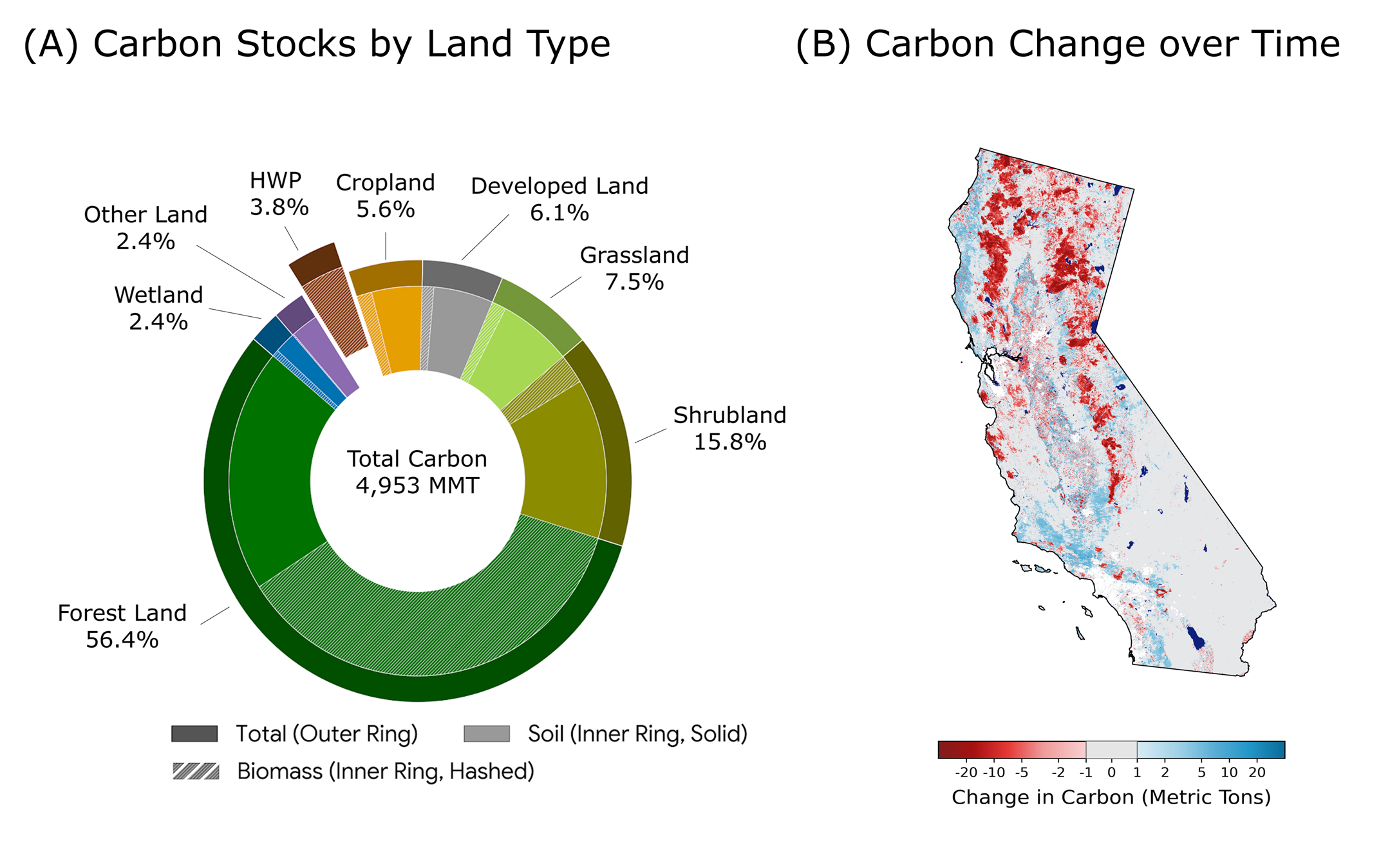
The 2025 NWL Carbon Inventory shows that in 2022, California’s NWL stored 4,953 MMT of carbon, with over half of that contained in forests. Statewide, from 2001-2022, lands in California gained carbon, sequestering about 45 MMT, equivalent to less than 1% of 2001 carbon stocks. However, between 2014-2022, carbon stocks declined by 214 MMT, or about 4%. Biomass carbon was the greatest contributor to statewide declines, followed by soil carbon. In both cases, reductions were concentrated in forests and previously forested areas that converted to shrubland or grassland. Over the same time period, harvested wood products experienced a slight increase in carbon stocks.
Elements of the 2025 Natural and Working Lands Carbon Inventory can be individually downloaded from the following links which cover the main body of the report as well as supporting Appendices A through C. Also provided are data shown in all figures as well as a single data table parsing the distribution of biomass carbon, soil organic carbon, total ecosystem carbon, and greenhouse gas fluxes (wetlands only) by year, county, air district, ownership, fifth climate change assessment region, ecoregion as defined by the US Forest Service (Class III), and landcover (see Parsed Carbon Inventory Data).
- CARB 2025 Natural and Working Lands Carbon Inventory
- Appendix A: Effects of Fire and Forest Management
- Appendix B: Technical Documentation
- Appendix C: Supporting Results
- CARB 2025 NWL Carbon Inventory Main Report: figure data
- Appendix A: figure data
- Appendix B: figure data
- Appendix C: Statewide figure data
- Appendix C: Forest figure data
- Appendix C: Shrubland figure data
- Appendix C: Grassland figure data
- Appendix C: Other Lands figure data
- Appendix C: Wetlands figure data
- Appendix C: Croplands figure data
- Appendix C: Developed Lands figure data
- Appendix C: Harvested Wood Products figure data
- Parsed Carbon Inventory Data